The bees’ natural mission
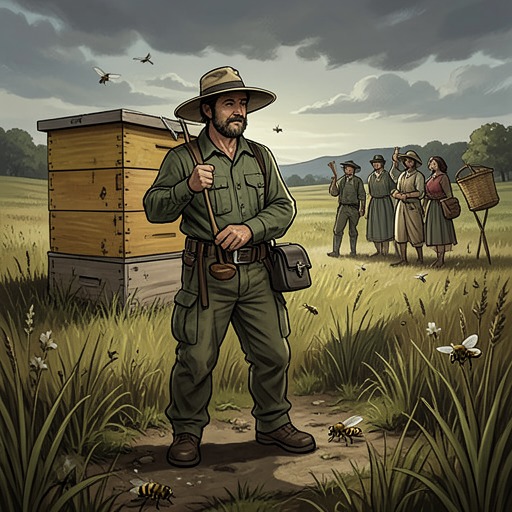
Grey BeesThe bees’ natural mission is both a biological imperative and the principle by which Sergey Sergeyich understands his own responsibilities. His bees must keep their hives warm, gather pollen, and sustain their colonies; because war threatens those ordinary tasks, he moves them toward safety. Their needs give his escape its purpose, while their disciplined, nonhuman life offers a contrast to human violence and political disorder.
A life governed by the hive
The bees’ need for warmth is a practical fact that Sergey Sergeyich explains repeatedly. A hive stays at thirty-seven degrees because the bees generate heat themselves; they cannot simply sleep through winter, since they would freeze. When a neighbor asks whether they are awake, Sergey Sergeyich says that they have to keep working to maintain the hive’s temperature, comparing their need for constant labor with the need to put coal in a stove. The comparison makes their biology part of the same daily economy of fuel and survival that shapes human life.
That labor continues beyond winter. As spring approaches, Sergey Sergeyich plans to place the hives in an orchard and leave the bees to fly where they choose, whether toward one side of the divided landscape or the other. Their movement is not presented as a political declaration: the bees follow pollen, not borders. The beekeeper’s duty is to give them suitable conditions, then allow them to perform the work for which they are suited.
Care under the threat of war
When bombardment shakes the bee-shed, the bees rush against its walls and some burst through the door into the yard. Sergey Sergeyich feels powerless to calm them; he can only close the door and wait for the shelling to end. The scene makes the cost of war visible in a form he can hear and touch, even when he cannot protect the hive from the immediate violence. The bees’ fear does not make them a decorative image of his own distress: their confinement and agitation are real dangers to the living colonies he tends.
His decision to leave follows from that vulnerability. He shuts the hives’ entrances so the bees will not scatter on the road, loads them onto a flatbed trailer, covers them against the rain, and straps them down. He also packs jars of honey, which he treats as a store of value that can be exchanged for food. Cool, rainy weather makes the journey safer because heat and rough roads could agitate the bees and raise the temperature inside the hives until they die. Transport is therefore not simply an escape from danger; it is a carefully managed extension of his responsibility for their survival.
Work, livelihood, and companionship
Sergey Sergeyich’s identity is bound to the bees’ health and activity. In summer, he hears the ringing of their wings as proof both that the colonies are alive and that he is present in the world as their keeper. He calls himself their representative, but does not claim authority over the colony’s ordinary social life. Worker bees and drones, he thinks, have their own affairs; his responsibility is to watch the colonies’ health, drive away wasps, uncap combs to extract honey, and collect wax and pollen. The work joins his livelihood to the bees’ labor without making their lives merely an extension of his own.
That interdependence also sustains his new life after he relocates the apiary. He eats bread and sausage received in exchange for honey and regards the bees’ ongoing work as evidence that spring has begun around him. He believes he has cared for them through winter by protecting them from cold and explosions, though he recognizes that his control over events is limited. In summer, a buyer’s claim that his honey is “anti-alcoholic” helps it sell in neighboring villages; the income gives him more confidence about the future. The commercial exchange supports him, but it does not replace the attentive daily relation between beekeeper and colony.
Nature as measure and limit
Watching the hive entrances, Sergey Sergeyich sees bees bringing pollen home and observes guard bees forcing weakened drones out before the cold season. He interprets this behavior through human social categories, contrasting the workers’ labor with the drones’ consumption and imagining the workers’ contempt for those who do not contribute. The comparison expresses his recurrent disappointment in human society, which he finds less wise than nature. It remains his interpretation of bee behavior, however, rather than proof that a colony’s order can be applied as a rule for human politics.
The bees’ most important distinction from people is not that they are morally flawless, but that their lives are not organized around war. Sergey Sergeyich thinks that people can switch between peace and war, whereas bees cannot understand that change. Their task is to collect and spread pollen, and the beekeeper imagines them carrying it among blossoming herbs and fruit trees. This account makes their mission at once ecological and intimate: their movement connects plants and seasons, while his care for them gives him a reason to seek a quieter place.
Fragility, recovery, and loss
The care required by a colony is expressed in small, deliberate acts. When a swarm gathers on a pear tree, Sergey Sergeyich sprays it with water to weigh down the bees’ wings and quiet their buzzing before sweeping them into a trap. He watches until the last bees have come down, concerned that none be left behind without the swarm or its queen. The scene presents his expertise as practical attention to a collective life whose survival depends on keeping its members together.
That care has a limit. At the end of the narrative, an explosion destroys a hive: where it stood there is a crater, scattered wood, and a fragment of comb, while a bee passes by. The abrupt loss breaks into the routine work of tending colonies and makes the contrast between the bees’ natural mission and human violence brutally concrete. Their lives remain directed toward pollen and the continuation of the hive, but the war can erase the material conditions on which that work depends. For Sergey Sergeyich, the mission is therefore neither a comforting abstraction nor a guarantee of safety; it is a fragile purpose he tries to preserve through labor, movement, and care.